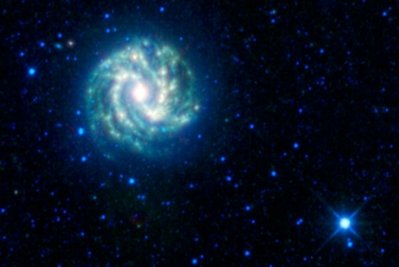
On the morning of February 1st, 2011, NASA’s Wide-field Infrared Survey Explorer, or WISE, took its last snapshot of the sky. This “last light” image is reminiscent of the “first light” image from WISE, taken only 13 months prior. WISE’s final picture shows thousands of stars in a patch of the Milky Way Galaxy, covering an area 3 times the size of the full Moon, in the constellation Perseus. In the upper left corner, a faint wispy cloud can be seen bending around a pulsating variable star called EV Persei.
The WISE Spacecraft transmitter was turned off for the final time at 12:00 noon PST on February 17. WISE Principal Investigator Ned Wright sent the last command. The Spacecraft will remain in hibernation without ground contacts awaiting possible future use.
Showing posts with label WISE. Show all posts
Friday, February 18, 2011
Wednesday, October 6, 2010
WISE Starts New Mission... Without Coolant
A prolific NASA space telescope that is mapping the entire sky has run out of vital coolant needed to keep its detectors from warming up, but that hasn't stopped its mission to seek out hidden asteroids, comets and other objects. NASA's Wide-field Infrared Survey Explorer, or WISE, is turning its camera eye on asteroids and comets within our solar system as part of its new NEOWISE Post-Cryogenic Mission.
This allows the space telescope to continue scanning the cosmos despite the lack of frozen hydrogen onboard to keep its infrared detectors as cold as designed. "Two of our four infrared detectors still work even at warmer temperatures, so we can use those bands to continue our hunt for asteroids and comets," said Amy Mainzer of NASA's Jet Propulsion Laboratory in Pasadena, Calif., in a statement. Mainzer is leading the WISE telescope's new mission.
Friday, July 16, 2010
25,000 New Asteroids Found by WISE
One of NASA's newest space telescopes has spotted 25,000 never-before-seen asteroids in just six months. Ninety-five of those are considered "near Earth," but in the language of astronomy that means within 30 million miles. Luckily for us, none poses any threat to Earth anytime soon.
Called WISE for Wide-field Infrared Survey Explorer, the telescope completes its first full scan of the sky on Saturday and then begins another round of imaging.
Subscribe to:
Posts (Atom)