Thursday, July 15, 2010

Ultrabright Gamma-ray Burst "Blinded" Swift

A flash of light that likely signaled the birth of a black hole was so bright it briefly blinded a NASA telescope—even though the light came from five billion light-years away. From its orbit around Earth, the Swift telescope has been scanning the skies since 2004 for mysterious, ultrabright flashes known as gamma-ray bursts.

Swift was designed to look for these bright events and study the initial flash of gamma rays and high-energy x-rays as well as the "afterglow" of lower-energy x-rays and ultraviolet light. Even though it can’t scan the whole sky at once, the telescope typically finds about two gamma-ray bursts a week. But on June 21 a rush of light from a minute-long gamma-ray burst proved so overwhelming that Swift’s data processing software temporarily shut down.

Planet With Unique Comet-Like Tail Discovered

Astronomers using NASA's Hubble Space Telescope have confirmed the existence of a baked object that could be called a "cometary planet." The gas giant planet, named HD 209458b, is orbiting so close to its star that its heated atmosphere is escaping into space.

Observations taken with Hubble's Cosmic Origins Spectrograph (COS) suggest powerful stellar winds are sweeping the cast-off atmospheric material behind the scorched planet and shaping it into a comet-like tail

Monday, July 12, 2010

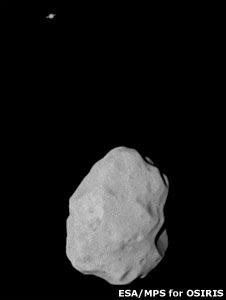
Rosetta probe passes Asteroid Lutetia

Europe's Rosetta space probe has flown past the Asteroid Lutetia, returning a stream of scientific data for analysis. The rock - some 120km (75 miles) in its longest dimension - is the biggest asteroid yet visited by a satellite.

Pictures showed Lutetia to be quite irregular in shape, its surface marked by a number of wide impact craters and even some intriguing grooves. Rosetta's encounter with the asteroid occurred some 454 million km from Earth, beyond the orbit of Mars.

Saturday, July 10, 2010

Total Solar Eclipse of 2010 July 11

On Sunday, 2010 July 11, a total eclipse of the Sun is visible from within a narrow corridor that traverses Earth's southern Hemisphere. The path of the Moon's umbral shadow crosses the South Pacific Ocean where it makes no landfall except for Mangaia (Cook Islands) and Easter Island (Isla de Pascua).

The path of totality ends just after reaching southern Chile and Argentina. The Moon's penumbral shadow produces a partial eclipse visible from a much larger region covering the South Pacific and southern South America

Friday, July 9, 2010

Brand New Planet-Finding Technique

A team of astronomers from Germany, Bulgaria and Poland have used a completely new technique to find an exotic extrasolar planet. The same approach is sensitive enough to find planets as small as the Earth in orbit around other stars. The group, led by Dr Gracjan Maciejewski of Jena University in Germany, used Transit Timing Variation to detect a planet with 15 times the mass of the Earth in the system WASP-3, 700 light years from the Sun in the constellation of Lyra.


The TTV method is very attractive, because it is particularly sensitive to small perturbing planets, even down to the mass of the Earth. For example, an Earth-mass planet will pull on a typical gas giant planet orbiting close to its star and cause deviations in the timing of the larger objects' transits of up to 1 minute.

Tuesday, July 6, 2010

Planck's First Hi-Res Image

Researchers on the Planck telescope, the biggest cosmology experiment in nearly a decade, have released their first full sky map of the cosmic microwave background.

The image shows the Milky Way as a bright, horizontal band through the centre with "streamers" of cold dust extending above and below. But the interesting part to researchers is the scattering of yellow flecks in the red background. These oldest photons in the universe are thought to have been generated about 380,000 years after the Big Bang, when matter was finally cool enough to start forming atoms.

Watch While an Asteroid Eats a Star

In a rare event on July 8, 2010, skywatchers will be able to see an asteroid briefly block out the light from a star as it passes in front. It may be the only asteroid "occultation" this century observable with the naked eye.

During the night of 8/9 July, however, a star that is visible to the naked eye, Delta Ophiuchi (the fourth-brightest star in the constellation Ophiuchi), will be occulted by asteroid Roma, which has a diameter of about 50 km.

Thursday, July 1, 2010

Space Station Visible All Night Tonight

The International Space Station (ISS) has entered the "twilight zone," giving sky-watchers in select places around the world unprecedented multiple views of the orbiting facility tonight.

The space station isn't always visible at night when it passes overhead, because it spends about 30 percent of its time cloaked by Earth's shadow. But once a year the high-flying facility's orbit closely parallels what's known as the day-night terminator, the zone of perpetual twilight on the border between Earth's dayside and nightside. When it's in the zone, the ISS can be seen with the naked eye every time it passes overhead, from dusk til dawn.

Last Shuttle Flight Delayed until 2011

NASA made it official Thursday after weeks of hints of launch delays: More time is needed to get the cargo ready for the final two shuttle flights. What's more, a decision regarding a possible third — and really last — mission is off until at least next month.

Managers agreed to postpone the next-to-last shuttle launch until Nov. 1. Discovery had been scheduled to fly to the International Space Station with a load of supplies in September. The very last mission now has a Feb. 26, 2011, launch date. Endeavour will close out the 30-year shuttle program by delivering a major scientific instrument to the space station.

First Directly Imaged Planet Confirmed

A planet only about eight times the mass of Jupiter has been confirmed orbiting a Sun-like star at over 300 times farther from the star than the Earth is from our Sun. The newly confirmed planet is the least massive planet known to orbit at such a great distance from its host star. The discovery utilized high-resolution adaptive optics technology at the Gemini Observatory to take direct images and spectra of the planet.

First reported in September 2008 by a team led by David Lafrenière (then at the University of Toronto, now at the University of Montreal and Center for Research in Astrophysics of Quebec), the suspected planetary system required further observations over time to confirm that the planet and star were indeed moving through space together.